QMPD-1 – Bias & Control Unit
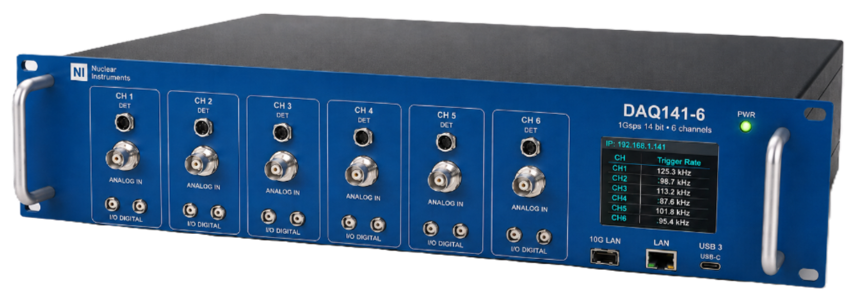
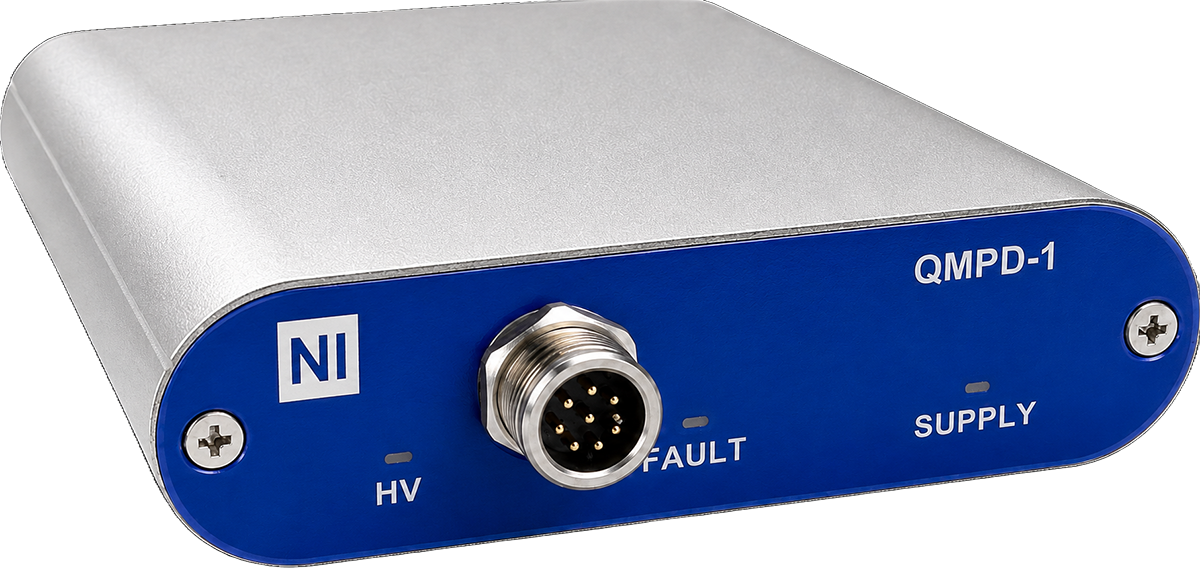
The QMPD-1 is the power supply and controller for the QMPD-2 detector head, designed to run the detector fully stand-alone, with no DAQ141-6 in the system. While a DAQ141-6 can power and control the head directly, the QMPD-1 supplies everything the detector needs from a single compact box — making it the natural companion when the QMPD-2 is used with the 32-channel DAQ141 or in any setup without an integrated front-end supply.
Over the single M8 cable it delivers the programmable SiPM high-voltage bias, the ±6 V ultra-low-noise preamplifier rails and the digital front-end gain control, while continuously monitoring output voltage and current:
- The high-voltage section provides a programmable SiPM bias from 20 to 85 V at up to 10 mA, with very low ripple (< 0.1 mVpp typical) and high-resolution voltage and current read-back. Programmable temperature compensation corrects the bias against the SiPM temperature coefficient, keeping the gain — and therefore the spacing of the photon-number peaks — stable over temperature.
- Front-end gain is set digitally: the QMPD-1 selects the variable-gain TIA feedback of the QMPD-2 (the 20 / 50 / 150 / 200-photon ranges), matching the optical dynamic range to the measurement with no manual intervention on the detector head.
Why QMPD-1
- 20 ÷ 85 V (10 mA) programmable bias output, suitable for large SiPM matrices
- Very low ripple (< 0.1 mVpp typical)
- ±6 V ultra-low-noise preamplifier supply
- Digital front-end gain control of the QMPD-2
- Analog and digital control (UART, I²C, analog & USB)
- High-resolution voltage and current monitoring
- Programmable temperature compensation
- Multi-unit addressing over the I²C bus
- ZEUS 2 control software · open-source C & Python libraries (GitHub)
High-Voltage & Preamplifier Supply
The QMPD-1 delivers both the SiPM bias and the preamplifier rails to the QMPD-2 detector head over a single M8 cable:
- Programmable SiPM bias from 20 to 85 V, up to 10 mA — suitable not only for a single QMPD-2 but also for large SiPM matrix assemblies
- Ultra-low ripple (< 0.1 mVpp typical) for minimal noise injection
- ±6 V ultra-low-noise rails for the QMPD-2 variable-gain TIA and output stage
- High-resolution voltage and current monitoring for diagnostics and safety
Temperature Compensation
Programmable temperature compensation corrects the bias voltage against the SiPM temperature coefficient, keeping the detector gain — and therefore the spacing of the photon-number peaks in the pulse-height spectrum — stable over temperature. The QMPD-1 reads the SiPM temperature over the one-wire bus embedded in the M8 cable and adjusts the bias in real time according to a user-programmed coefficient.
Control & Monitoring
The QMPD-1 exposes multiple control interfaces for integration into any measurement setup:
- USB — direct connection to a PC running ZEUS 2 or custom scripts
- UART / I²C — embedded control for multi-unit arrays; an open-source C library supports several QMPD-1 units on a single I²C bus
- Analog — analog control input and high-resolution voltage / current monitoring outputs for scope or external data acquisition
Digital Front-End Gain Control
The QMPD-1 remotely selects the variable-gain TIA feedback of the QMPD-2 (the 20 / 50 / 150 / 200-photon ranges), matching the optical dynamic range to the measurement with no manual intervention on the detector head. This allows real-time adaptation to varying light levels and automated measurement sequences.
ZEUS 2 Control Software
Both the HV bias and the front-end gain are managed from ZEUS 2, the control application for the QMPD-1. Connected over USB (or Ethernet / I²C), ZEUS 2 lets the user set and read back the SiPM bias voltage and the detector gain range, monitor live voltage, current and temperature, enable temperature compensation and store per-device calibration. The same functions are exposed programmatically through open-source C and Python libraries, and the I²C bus allows several QMPD-1 units to be addressed together — so a multi-detector array can be configured and monitored from one ZEUS 2 session or script.
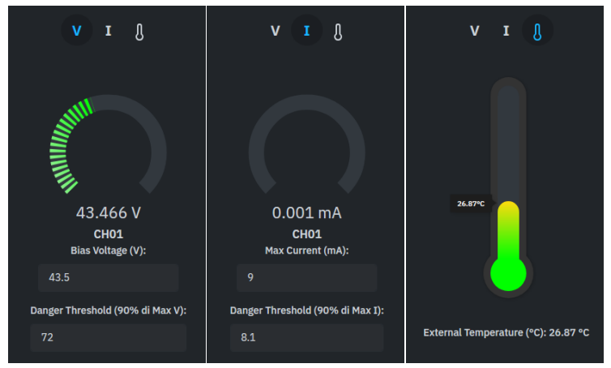
ZEUS 2 live monitoring: per-channel SiPM bias voltage, current and temperature, each with an editable set-point and a configurable danger threshold.
ZEUS 2 live monitoring: per-channel SiPM bias voltage, current and temperature, each with an editable set-point and a configurable danger threshold.
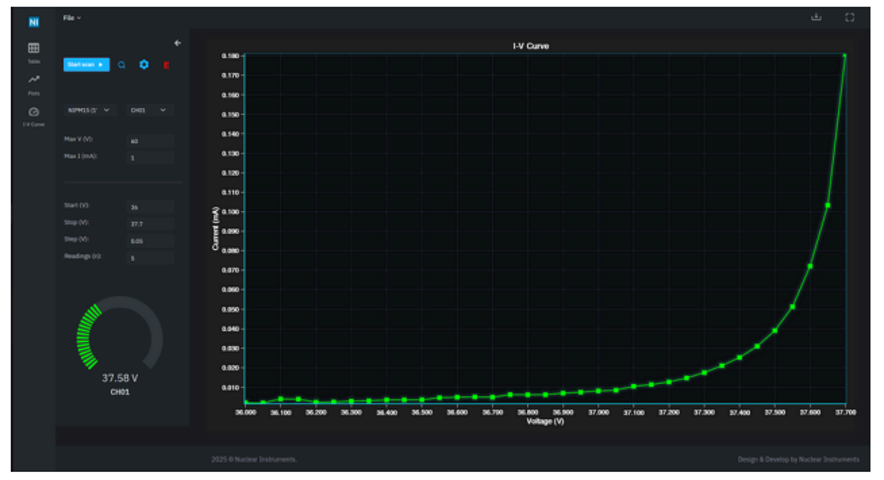
ZEUS 2 I–V curve tool: an automated bias sweep that traces the SiPM current-vs-voltage characteristic for breakdown-voltage extraction and diagnostics.
ZEUS 2 I–V curve tool: an automated bias sweep that traces the SiPM current-vs-voltage characteristic for breakdown-voltage extraction and diagnostics.
Features
- USB / UART / I²C control interfaces
- Set and read back SiPM bias voltage and detector gain range
- Live monitoring of voltage, current and temperature
- Programmable temperature compensation
- Per-device calibration storage
- Multi-unit addressing over I²C for detector arrays
- Open-source C and Python libraries (GitHub)
Part of the QuantumBox System
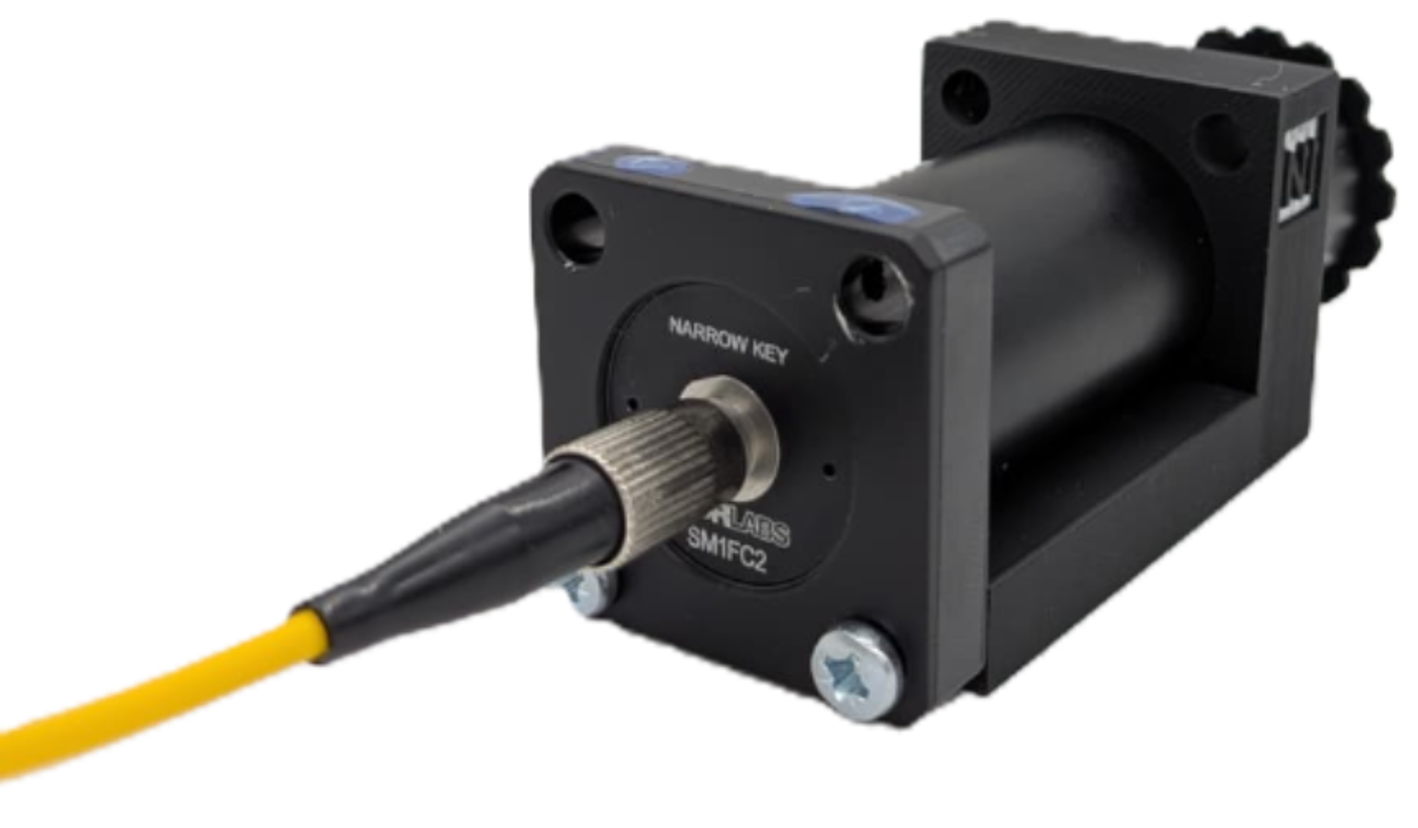
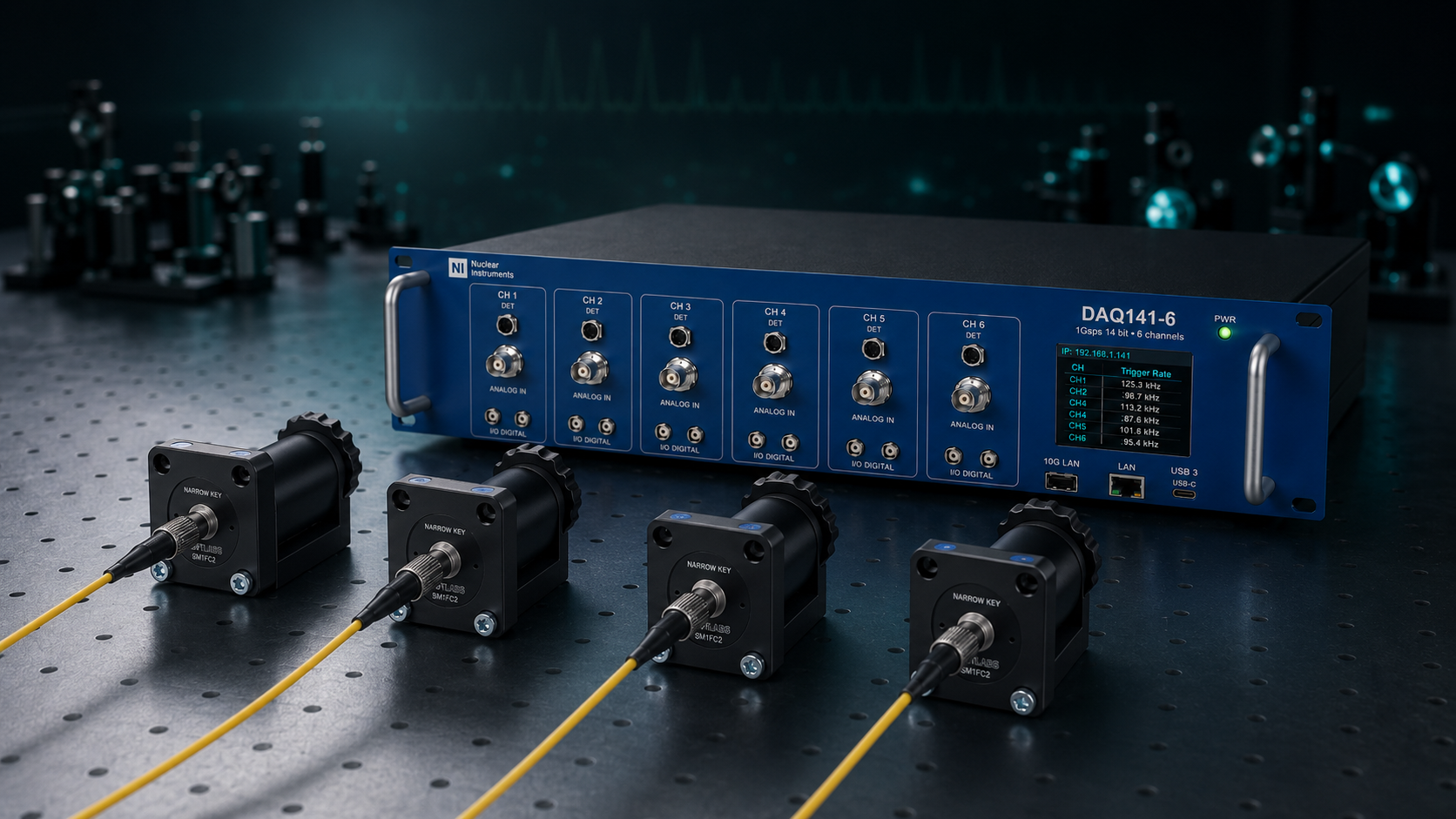
The QMPD-1 is a component of the QuantumBox photon-number-resolving detection chain, providing power and control for the QMPD-2 detector head: