QUANTA – Quantum Photon Counter & Timer Software
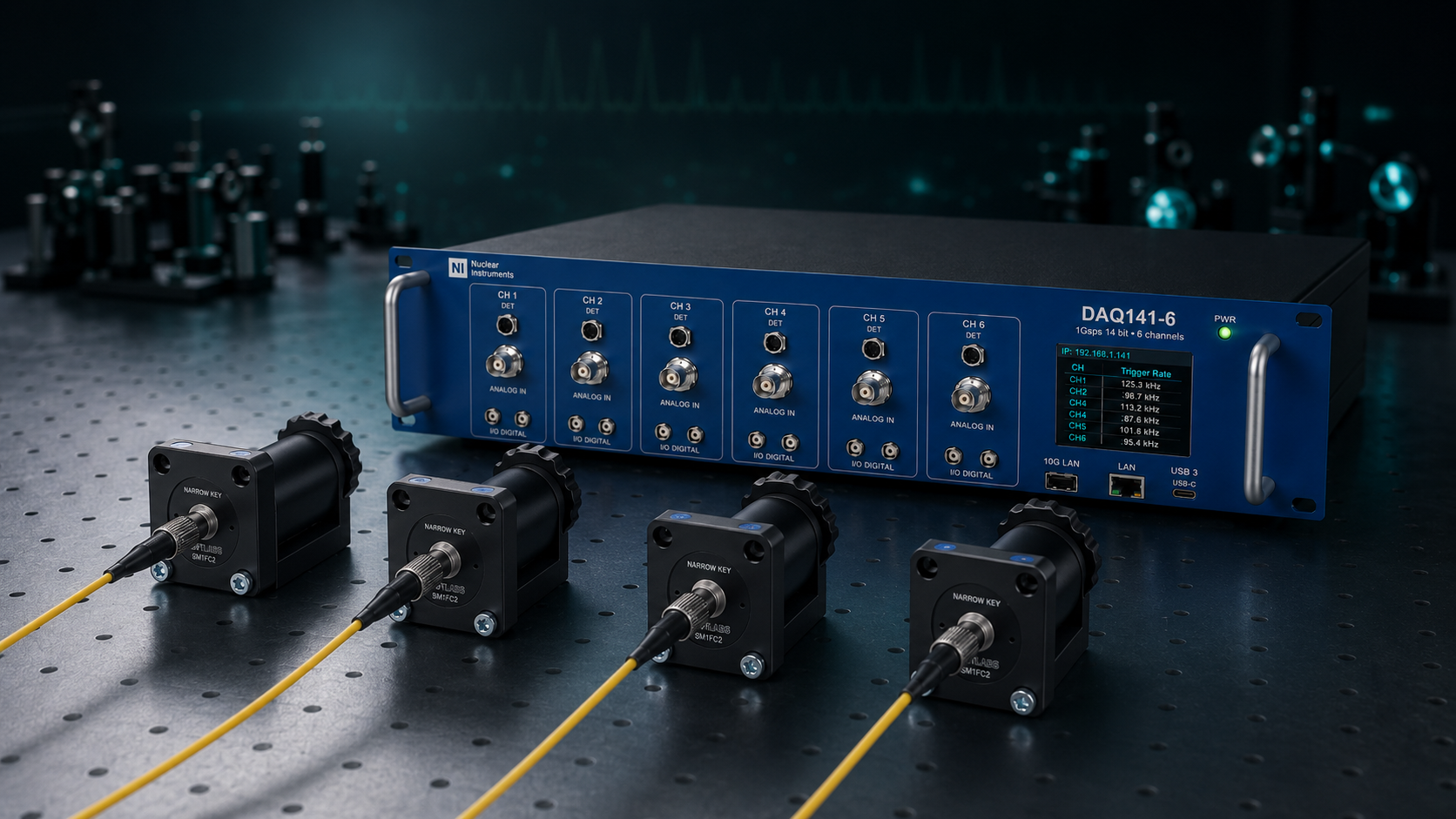
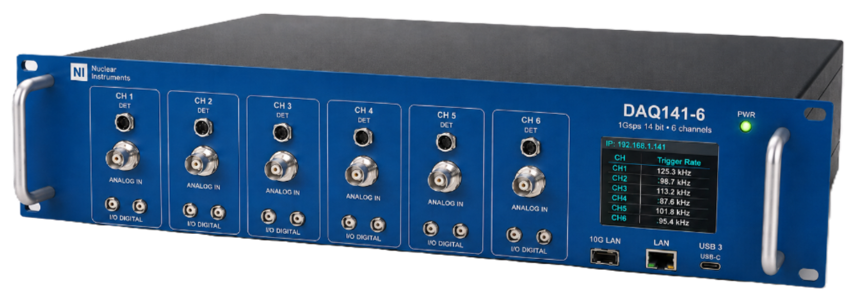
QUANTA is the complete acquisition and analysis software for the Nuclear Instruments digitizer platform — the software layer of the QuantumBox chain. From single photons to quantum correlations, it turns a DAQ141-6 or DAQ141 digitizer into a turnkey photon-counting and timing instrument, with a coherent dark-themed interface.
QUANTA covers the full experimental workflow — signal visualization, energy calibration with automated peak fitting, photoelectron classification, cross-channel quantum correlations, inter-arrival and cross-channel timing, and hardware coincidence monitoring — all processed in real time at up to millions of events per second (up to 60 M/s in counting mode and 156 M/s in timing mode over 10 GbE), while data stays accessible for offline analysis and export.
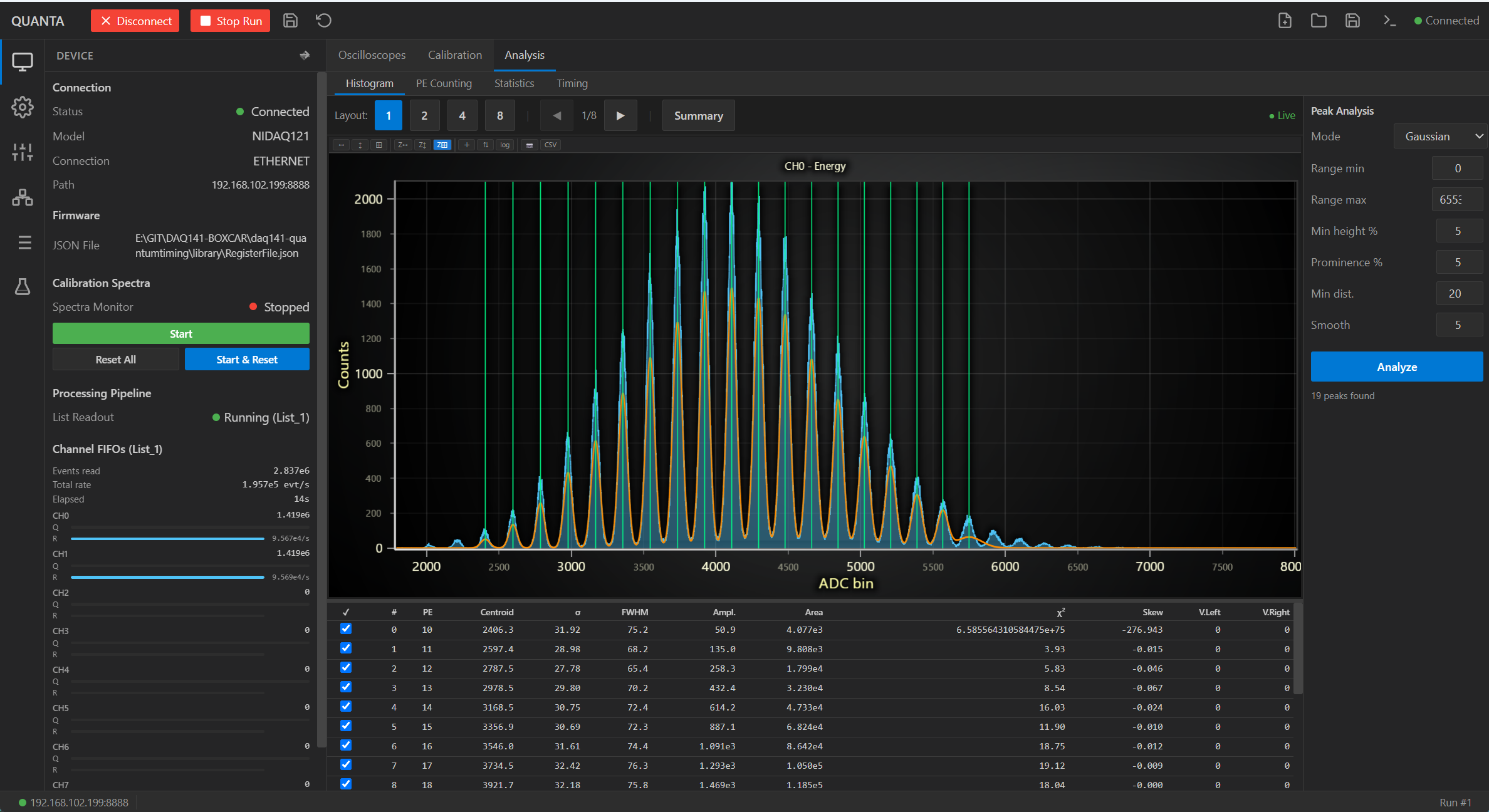
QUANTA: live calibration spectra, per-channel processing pipeline and multi-photon peak identification in a single dark-themed application.
QUANTA: live calibration spectra, per-channel processing pipeline and multi-photon peak identification in a single dark-themed application.
Two Operating Modes
QUANTA runs the same hardware in two complementary modes — one optimized for how many photons arrive, the other for when they arrive.
⬤ Photon Counting — with Quantum Correlations
Measure photon-number distributions and the quantum correlations between beams: beamsplitter and twin-beam experiments, squeezed-light characterization, sub-shot-noise metrology.
- A common trigger gates all channels simultaneously, so every beam is sampled on the same event
- 16-bit energy resolution via charge integration (QDC) or peak detection
- Real-time photoelectron (PE) classification using calibrated thresholds — the exact photon number per pulse
- Cross-channel quantum correlations computed live: second-order coherence g₁₁, Noise Reduction Factor (NRF < 1 certifies sub-shot-noise correlations), Pearson coefficient γ, Fano factor and g⁽²⁾(0)
- 2D joint-probability heatmaps (PE×PE, Energy×Energy) and time-resolved waterfall displays
- Inter-arrival time distribution for source characterization
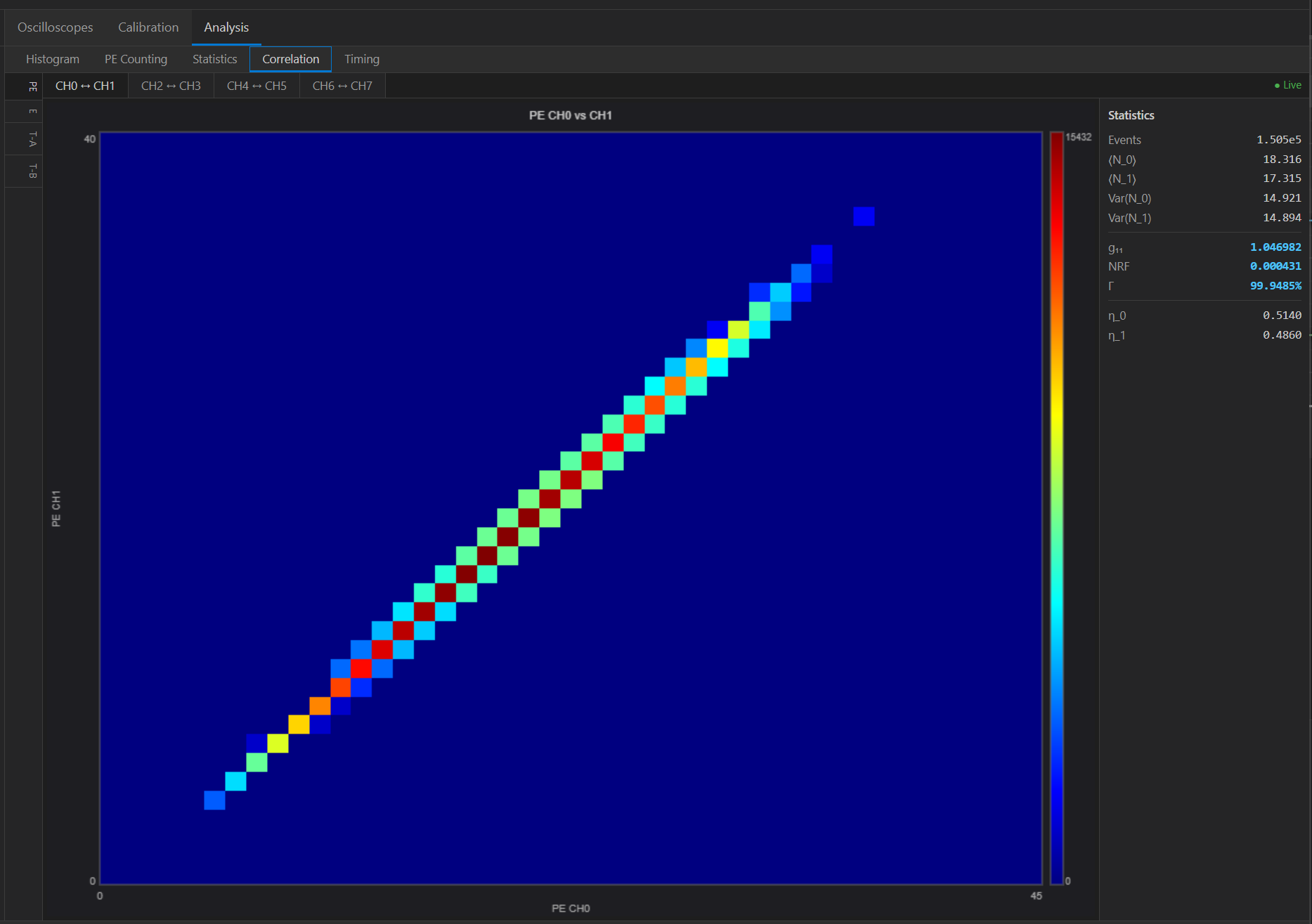
Live 2D photon-number correlation heatmap between two channels, with g₁₁, NRF and γ computed in real time from online statistics accumulators.
Live 2D photon-number correlation heatmap between two channels, with g₁₁, NRF and γ computed in real time from online statistics accumulators.
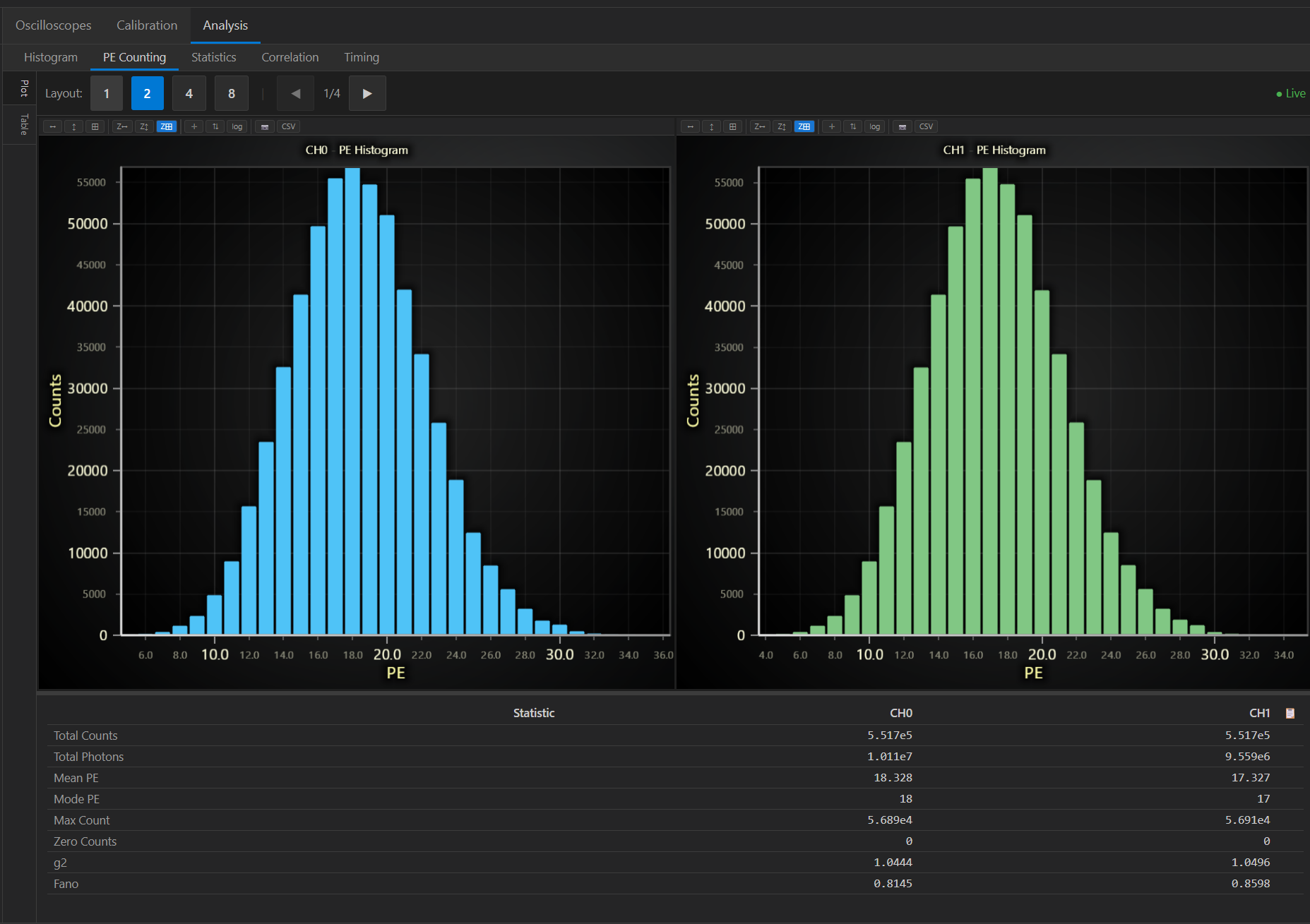
Photoelectron-number distributions per channel, with mean, mode, Fano factor and g⁽²⁾(0).
Photoelectron-number distributions per channel, with mean, mode, Fano factor and g⁽²⁾(0).
⬤ Photon Timing — 10 ps Resolution & Photon-Number Resolution
Time-correlated single-photon counting (TCSPC), fluorescence-lifetime measurement, arrival-time tagging and coincidence counting — with per-channel independent triggering.
- ~10 ps timing resolution with the digital Constant Fraction Discriminator (CFD); 4 ns with Leading-Edge triggering
- Photon-number resolution retained in timing mode: a 14-bit amplitude is recorded with every timestamp, so each event carries both its arrival time and its photon number
- User-defined time measurements: inter-arrival on any channel, or the time difference between any two channels
- Overflow-corrected timestamps for unlimited acquisition duration
- A comprehensive fitting system (Gaussian, multi-Gaussian, single/multi-exponential, Voigt, log-normal) for lifetimes, jitter and coincidence-peak widths
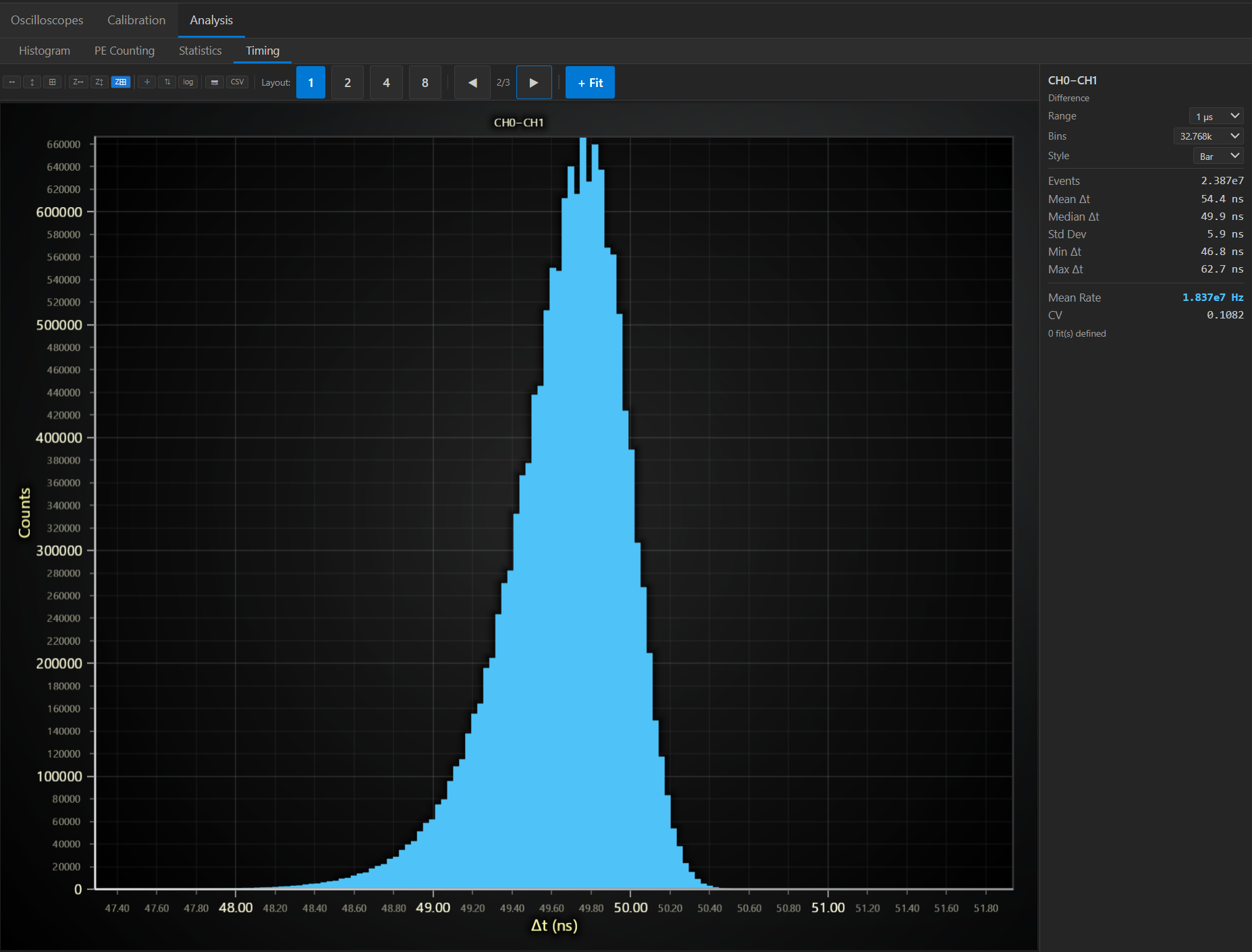
Cross-channel time-difference histogram: the coincidence-peak width measures the timing correlation between two channels down to the picosecond scale.
Cross-channel time-difference histogram: the coincidence-peak width measures the timing correlation between two channels down to the picosecond scale.
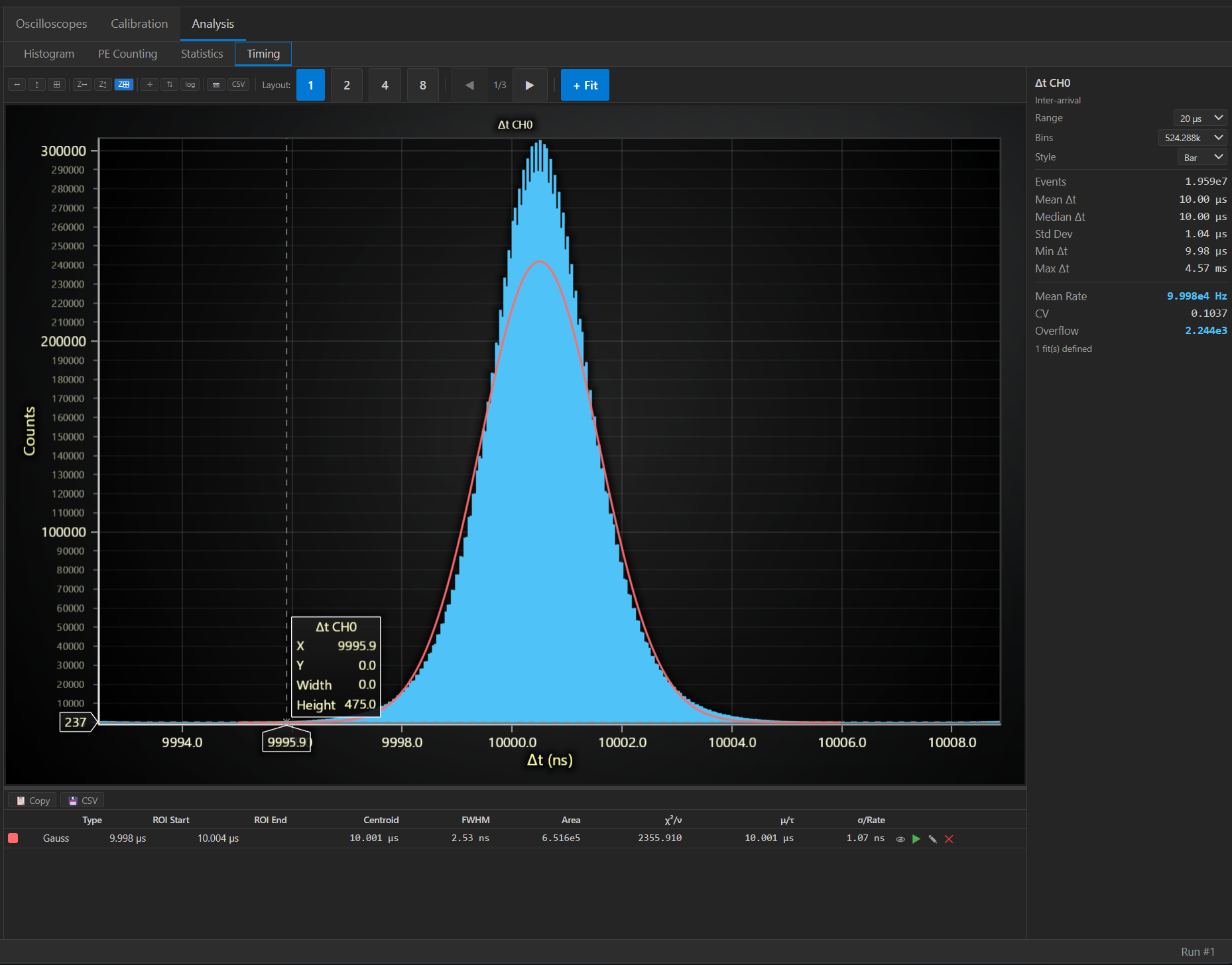
Inter-arrival time distribution — exponential for Poissonian sources, revealing the underlying photon statistics.
Inter-arrival time distribution — exponential for Poissonian sources, revealing the underlying photon statistics.
Configurable Hardware Coincidences — up to 100 MHz
QUANTA drives and monitors independent, fully configurable hardware coincidence units. Each unit has a programmable channel mask, with per-channel trigger width and delay for precise alignment, and the coincidence logic runs in the digitizer FPGA so it sustains event rates up to 100 MHz — far beyond what any software correlator could handle.
Coincidence rates are displayed live as time-series charts with a per-unit percentage breakdown, and can be dumped to CSV at a configurable interval for long unattended runs.
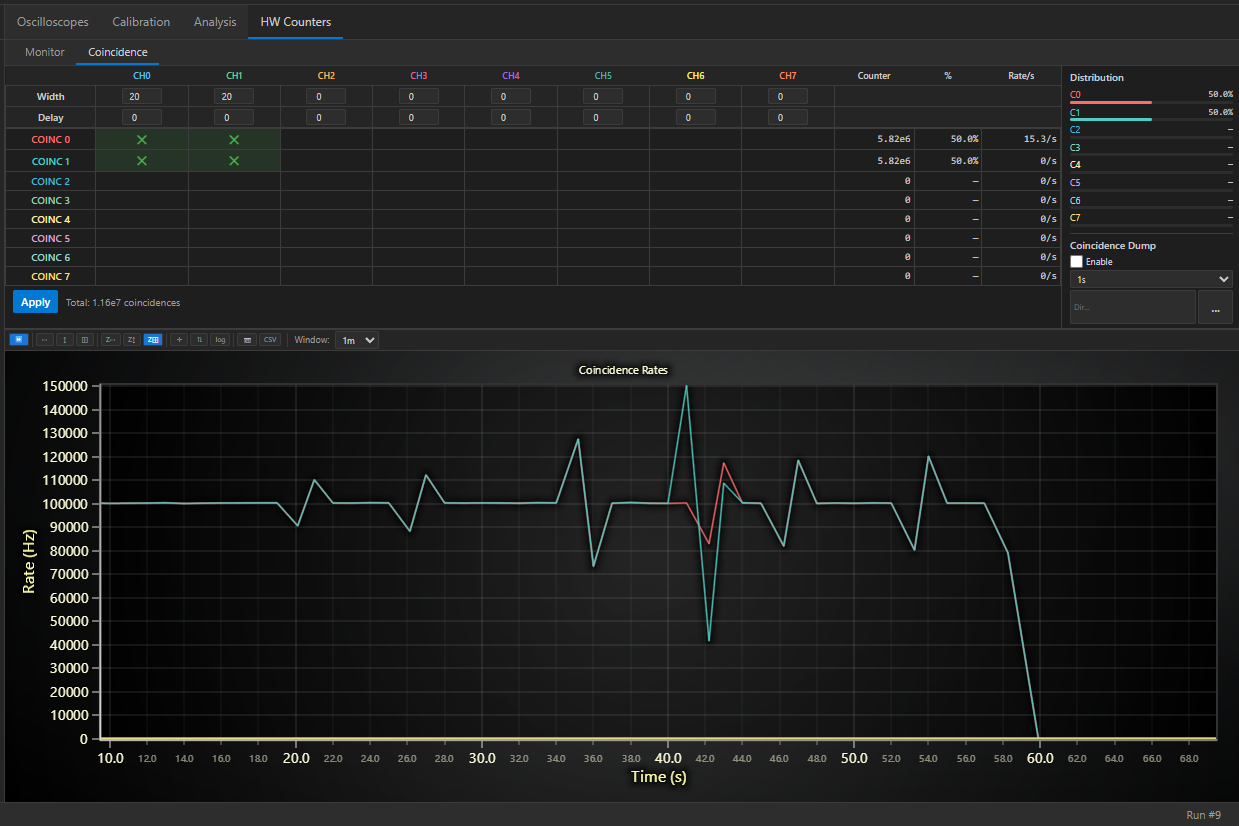
Hardware coincidence configuration and live coincidence-rate monitoring — programmable channel masks, per-channel width and delay, running in the FPGA at up to 100 MHz.
Hardware coincidence configuration and live coincidence-rate monitoring — programmable channel masks, per-channel width and delay, running in the FPGA at up to 100 MHz.
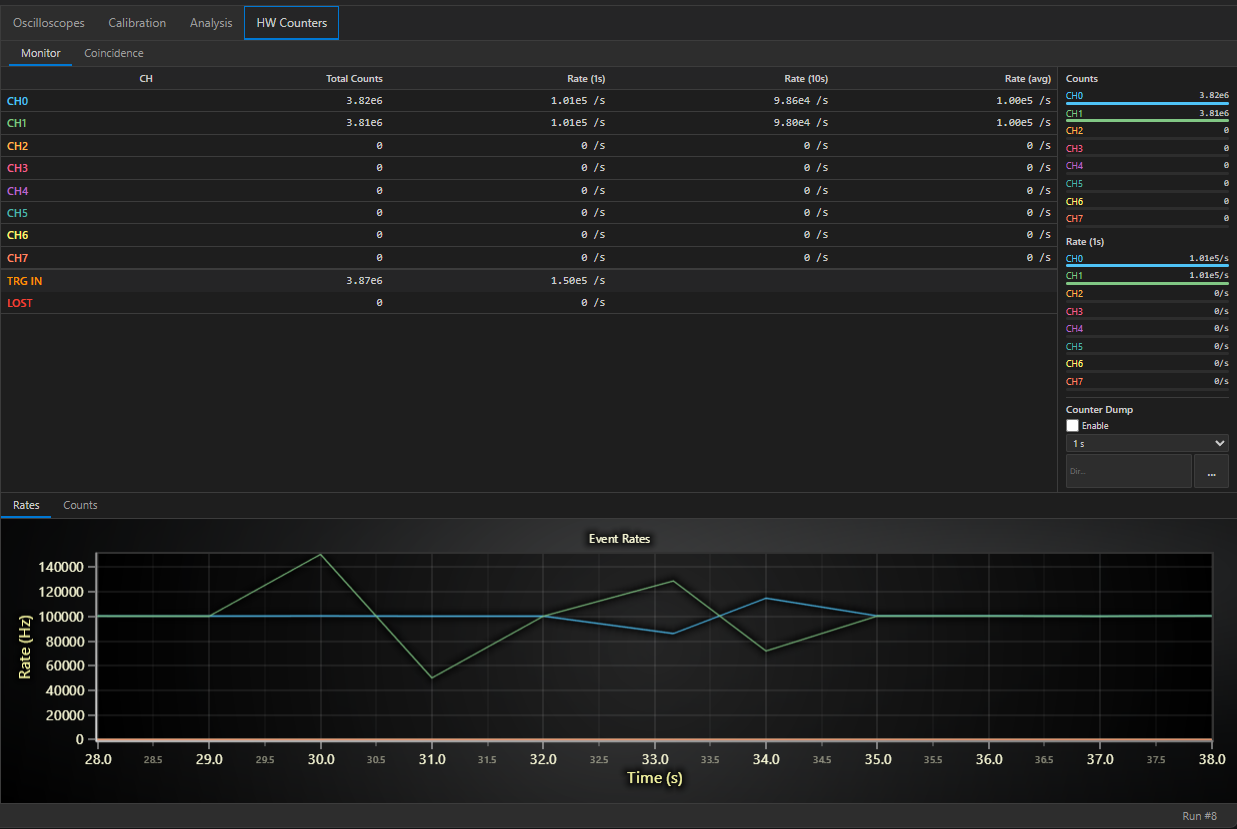
Real-time hardware event counters and rate history.
Real-time hardware event counters and rate history.
Signal Setup & Energy Calibration
A real-time multi-channel oscilloscope lets the user inspect raw detector signals before acquiring: the trigger view overlays the analog input with the CFD output and the digital trigger/gate/inhibit signals, while each channel shows its input alongside the QDC integration window or CFD discriminator output. Time base, trigger level, pre-trigger, and per-channel scale and offset are all configurable.
Energy calibration uses an automated log-parabola Gaussian peak-fitting method: the software detects the photoelectron peaks, fits each with a Gaussian (centroid, sigma, FWHM, area, χ²) and assigns a PE number from the zero-peak reference, computing the classification thresholds from the valleys between peaks. Iterative refitting across sessions keeps the calibration stable over time.
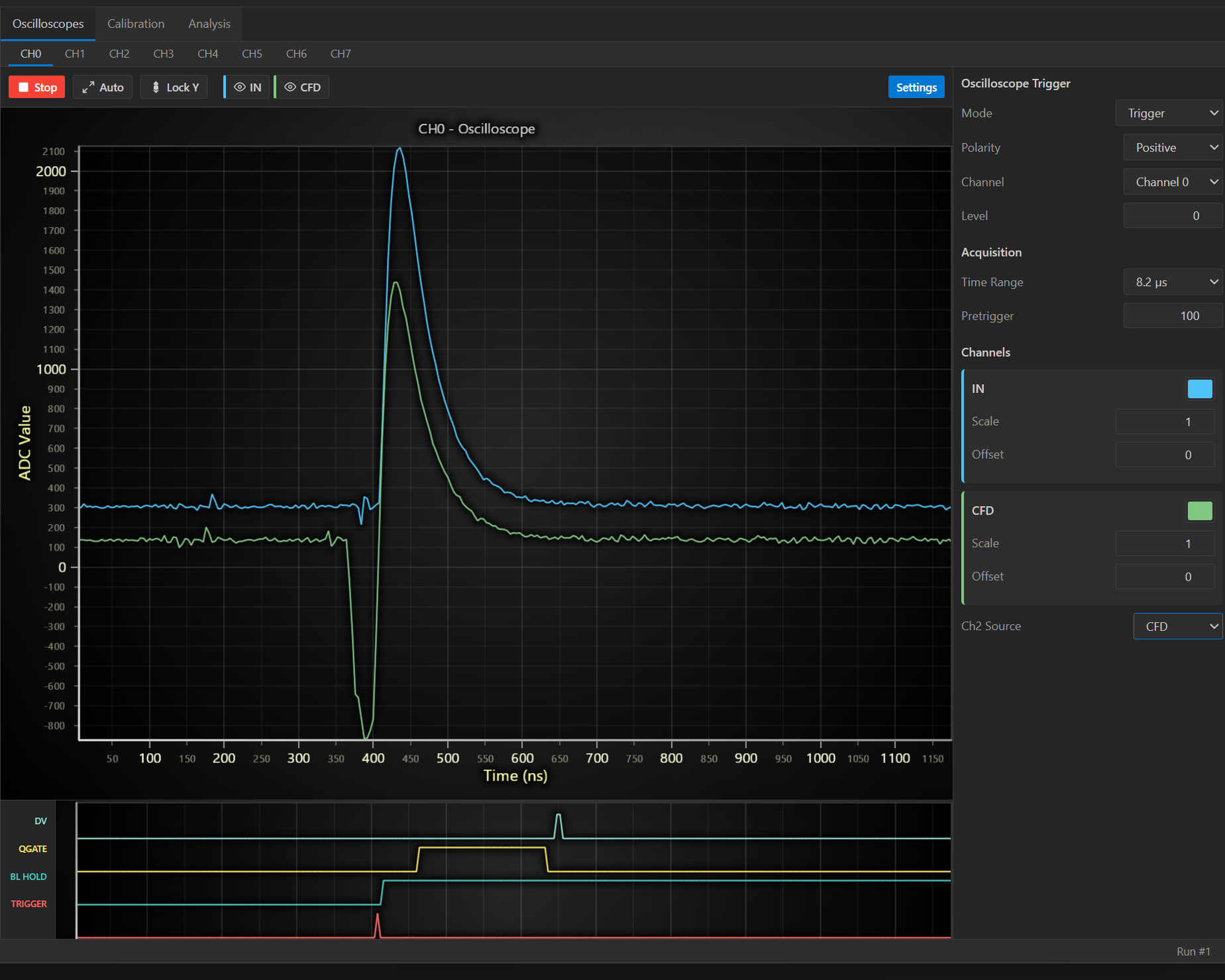
Real-time oscilloscope with CFD parameter visualization for trigger and timing setup.
Real-time oscilloscope with CFD parameter visualization for trigger and timing setup.
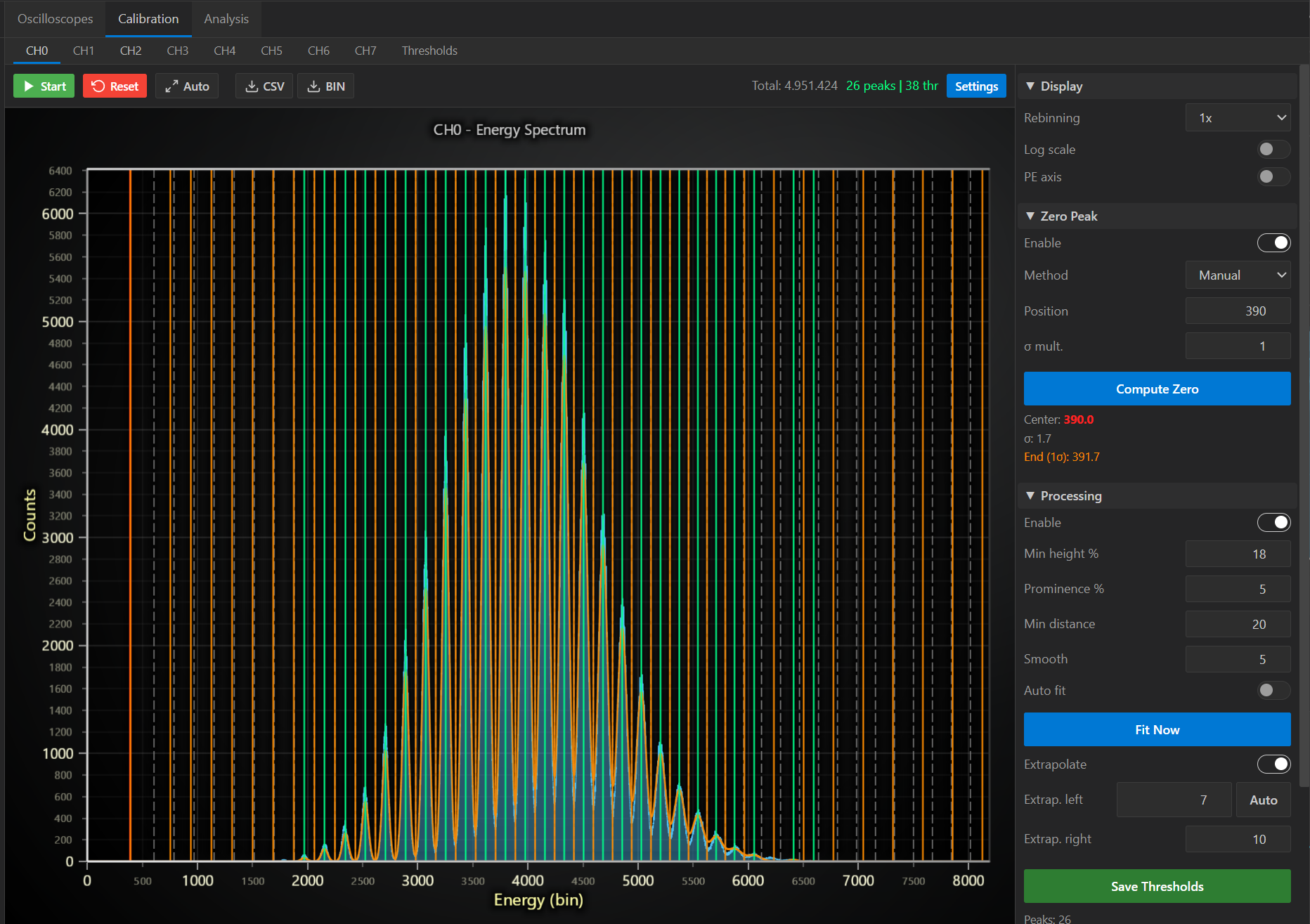
Automated multi-photon peak fitting with per-PE threshold assignment.
Automated multi-photon peak fitting with per-PE threshold assignment.
Real-Time Analysis Dashboard
During acquisition every panel updates continuously, and all data stays accessible after the run — navigate, zoom, fit and export with no data loss:
- Amplitude histograms with per-channel Gaussian analysis and a cross-channel summary
- PE counting distributions with mean, mode, Fano and g⁽²⁾(0)
- A statistics table of per-channel metrics (counts/s, PE stats) and per-pair correlations — right-click any value to add it to a live time-series plot
- Correlation heatmaps and energy waterfall displays for time-resolved behaviour
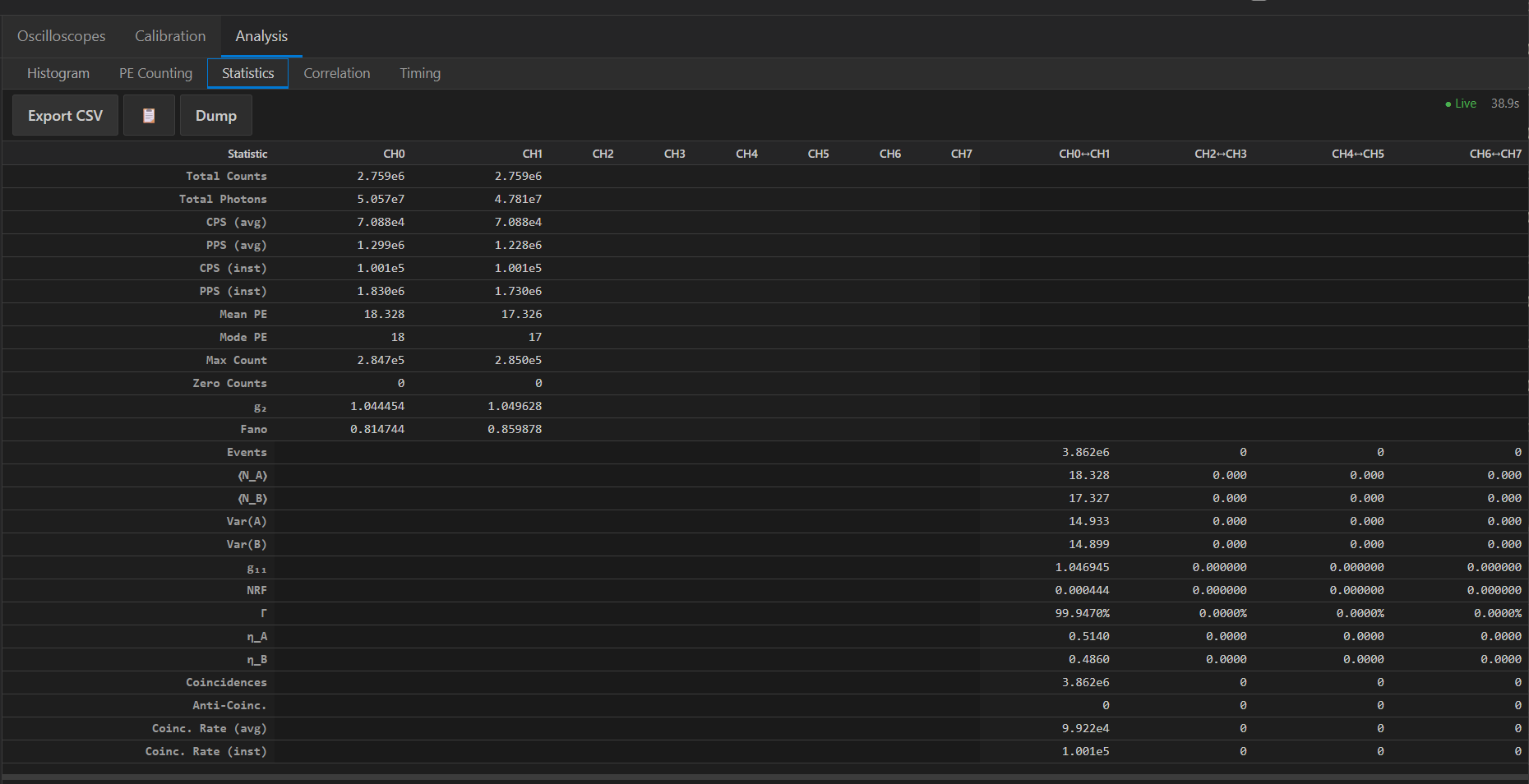
Per-channel and per-pair statistics dashboard; any value can be streamed to a live time-series plot.
Per-channel and per-pair statistics dashboard; any value can be streamed to a live time-series plot.
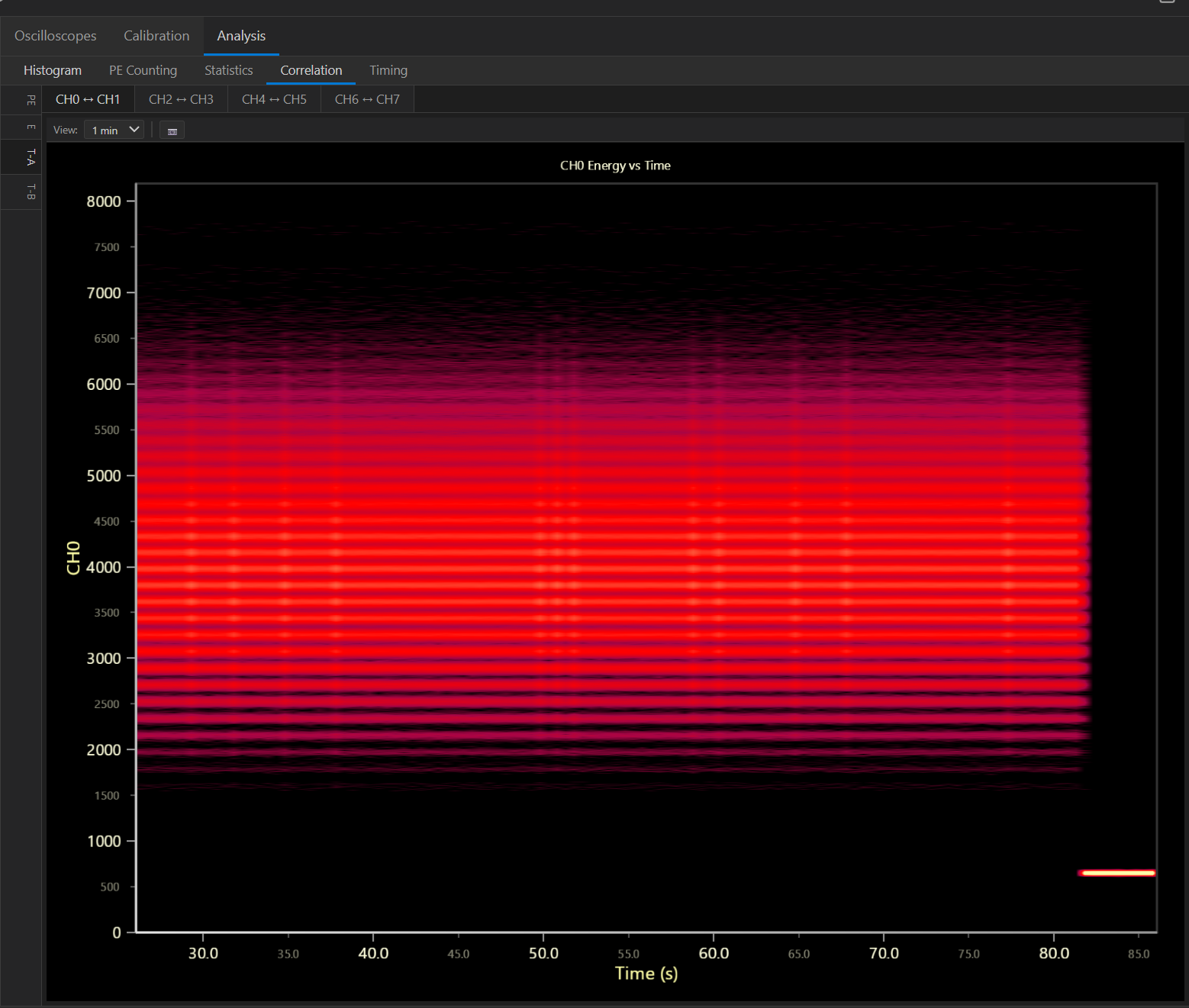
Energy waterfall display for monitoring time-resolved spectral evolution.
Energy waterfall display for monitoring time-resolved spectral evolution.
Technical Specifications
| Specification | Value |
|---|---|
| Energy resolution | 16-bit (Counting) / 14-bit (Timing) |
| Timing resolution | ~10 ps (CFD) / 4 ns (Leading Edge) |
| Photon-number resolution | Real-time PE classification (both modes) |
| Max sustained rate — Photon Counting | 6 M events/s (1 GbE) · 60 M events/s (10 GbE) |
| Max sustained rate — Photon Timing | 12.5 M events/s (1 GbE) · 156 M events/s (10 GbE) |
| Hardware coincidences | Configurable units, up to 100 MHz |
| Signal processing | QDC, Peak Holder, Digital Pole-Zero |
| Trigger modes | Common, Leading Edge, CFD |
| Correlation metrics | g₁₁, NRF, γ, Fano, g⁽²⁾(0), 2D histograms |
| Fit models | 8 (Gaussian, multi-Gaussian, exponential family, Voigt, log-normal) |
| Export formats | Binary, CSV, Text, NumPy |
| Connection | Gigabit / 10 Gigabit Ethernet |
| Platform | Windows 10/11 (64-bit) |
| Compatible hardware | DAQ141-6 / DAQ141 digitizer platform |
Applications
- Quantum optics — photon statistics, squeezed light, entanglement verification
- Single-photon detection — SiPM and PMT characterization, PE-spectrum calibration
- TCSPC — fluorescence lifetime and time-resolved spectroscopy
- Quantum key distribution (QKD) — coincidence counting and timing correlations
- Detector R&D — multi-channel performance comparison and noise characterization
- Nuclear & particle physics — scintillator readout and timing-resolution measurement
Part of the QuantumBox System
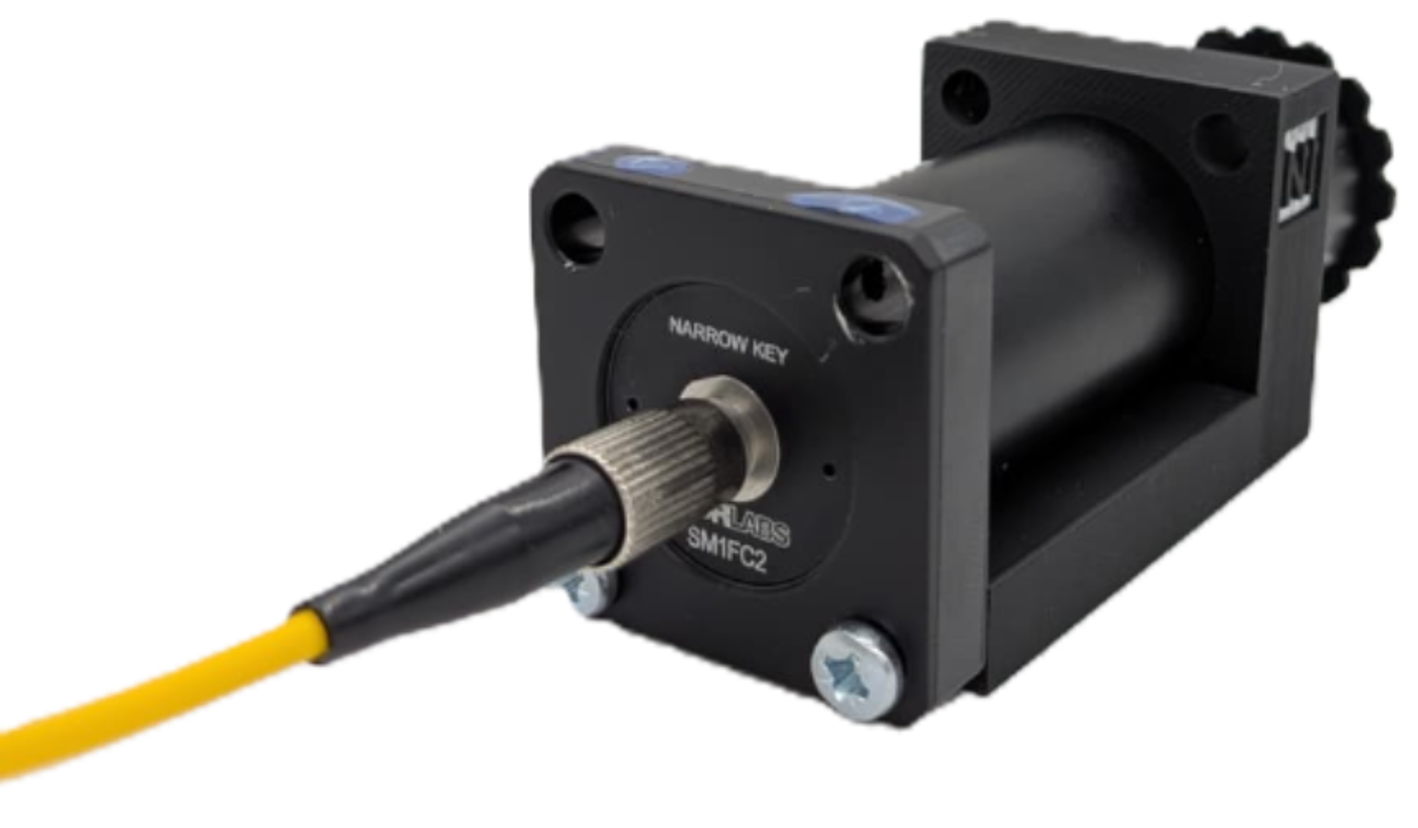
QUANTA is the software that drives the QuantumBox photon-number-resolving chain, together with the DAQ141-6 / DAQ141 digitizers and the QMPD detector heads.